 Arabic
 English
 French

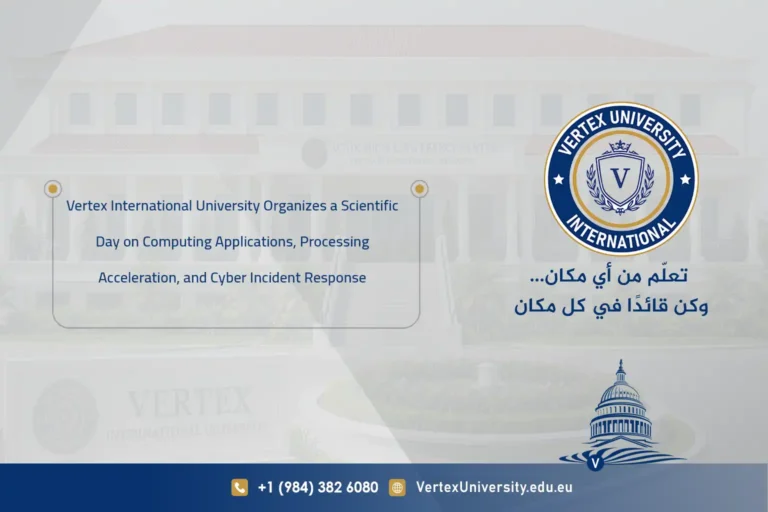
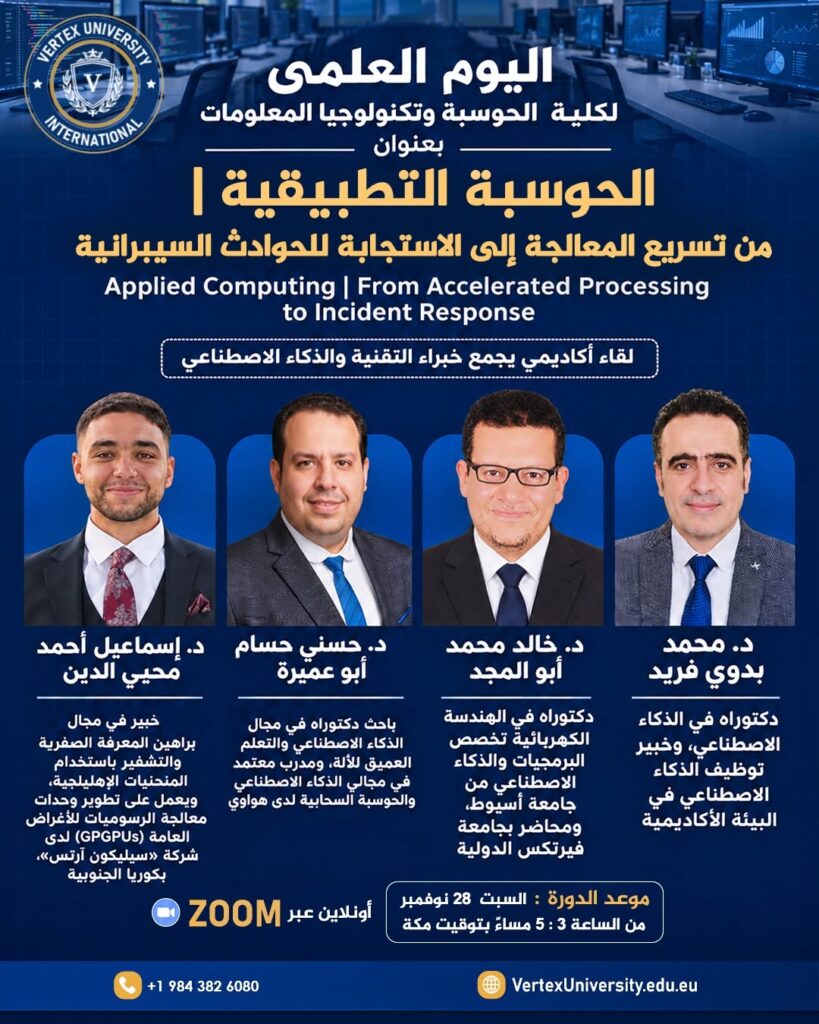
The Faculty of Computing and Information Technology at Vertex International University is organizing a scientific day entitled “Applied Computing | From Accelerated Processing to Incident Response” on Saturday, November 28, 2026, from 3:00 to 5:00 PM Mecca time, via Zoom. The event will bring together a group of specialists in artificial intelligence, parallel computing, digital forensics, and business process automation.
The scientific day explores a range of technological applications related to the development of digital systems, improving processing efficiency, and managing data. It features four specialized sessions presented by Dr. Mohamed Badawi Farid, Dr. Khaled Mohamed Abu Al-Magd, Dr. Ismail Ahmed Mohi El-Din, and Dr. Hosni Hossam Abu Omaira, offering participants an opportunity to explore advanced technical concepts and practical examples in modern computing.
Dr. Mohamed Badawi Farid Discusses Administrative Process Automation Using n8n
Dr. Mohamed Badawi Farid presents a session entitled “From Request to Report: Automating Administrative Work with n8n,” under the English title “Less Admin, More Impact: Workflow Automation with n8n.” The session explains how automation tools can reduce the time spent on repetitive administrative procedures and improve the management of daily operations.
The session begins by identifying tasks that can be automated, such as data entry, sending confirmation messages, and tracking requests. It then moves on to building workflows using the n8n platform through a live application simulating student registration for a training workshop. The demonstration shows how submitting a registration form can automatically trigger a workflow, record the submitted information in a spreadsheet, and send a confirmation message to the student.
The session also explores how registration data can be used to prepare attendance lists, monitor the number of remaining available places, and notify the person in charge when the workshop reaches its capacity. This provides a practical model of how automation tools can be integrated into administrative procedures, from receiving a request to generating reports and monitoring outcomes.
Dr. Mohamed Badawi Farid combines his academic specialization in artificial intelligence with experience in its applications within academic environments. He serves as a faculty member specializing in artificial intelligence at the Faculty of Computer Science and Engineering at King Salman International University, and as Director of the Faculty’s Quality Assurance Unit.
Dr. Khaled Mohamed Abu Al-Magd Explores Digital Forensics and the Stages of Cyber Investigation
Dr. Khaled Mohamed Abu Al-Magd addresses the field of Digital Forensics, focusing on its objectives, the tools used, and the stages of a digital forensic investigation, from identifying and collecting evidence to analyzing, documenting, and preserving its integrity.
The session explains the differences between volatile and non-volatile digital evidence, as well as the importance of hashing techniques in verifying the integrity of files and evidence. It also examines the concept of the Chain of Custody and its role in documenting the transfer and handling of evidence throughout the investigation process.
In addition, the session covers Timeline Analysis and the examination of File Timestamps as methods that help reconstruct the sequence of digital activities and understand the events associated with cyber incidents.
The session draws on Dr. Khaled Mohamed Abu Al-Magd’s academic background in Electrical Engineering, with a specialization in Software and Artificial Intelligence from Assiut University, in addition to his role as a lecturer at Vertex International University.
Dr. Hosni Hossam Abu Omaira Discusses the Evolution of Natural Language Processing and Applications of Large Language Models
Dr. Hosni Hossam Abu Omaira explores the evolution of Natural Language Processing (NLP), from traditional rule-based systems to modern Large Language Models (LLMs), highlighting the technological developments that have expanded artificial intelligence systems’ ability to understand, analyze, and generate language.
The session focuses on six major applications of natural language processing in everyday life and professional environments. It also addresses challenges associated with the Arabic language, including morphological ambiguity and dialectal diversity, and explains how these challenges can be addressed using artificial intelligence models.
This session enables participants to explore the uses of language processing technologies in modern digital applications and understand the relationship between the development of language models and the needs of users and institutions, particularly in systems that rely on text analysis and natural language interaction.
Dr. Hosni Hossam Abu Omaira brings research experience in artificial intelligence and deep learning, in addition to his certification as a Huawei trainer in artificial intelligence and cloud computing.
Dr. Ismail Ahmed Mohi El-Din Explores Parallel Computing and Processing Acceleration Using GPU and CUDA
Dr. Ismail Ahmed Mohi El-Din provides an introduction to parallel computing and its applications in artificial intelligence, simulation, and image processing. The session explains the fundamental differences between Central Processing Units (CPUs) and Graphics Processing Units (GPUs), and how parallel processing capabilities can be used to execute general-purpose computational operations efficiently.
The session also introduces the CUDA programming model through a simplified programming example in C/C++, connecting theoretical concepts with practical application. It explains when GPU processing may be an appropriate option, alongside the factors that can limit the expected acceleration. Participants will also have the opportunity to ask questions and explore potential next steps in learning about this field.
The session draws on Dr. Ismail’s expertise in zero-knowledge proofs and elliptic-curve cryptography, as well as his work on developing General-Purpose Graphics Processing Units (GPGPUs) at Silicon Arts in South Korea.
Applied Computing and the Integration of Technologies in Digital Systems Development
The scientific day’s sessions reflect the expanding scope of applied computing and the interconnected role of its fields in building modern digital solutions. Parallel computing makes it possible to handle computationally intensive operations and accelerate their execution, while natural language processing technologies contribute to developing systems with greater capabilities in understanding texts and interacting with users. Digital forensics provides technical methods for examining incidents, analyzing their traces, and preserving evidence, while automation tools help connect procedures and data and improve the efficiency of administrative operations.
The integration of these fields highlights the importance of combining theoretical knowledge with practical application when working with modern technologies. Developing digital systems requires an understanding of the capabilities and limitations of available tools, selecting the appropriate technology for each problem, and considering data accuracy, integrity, and processing efficiency. Exploring these applications also enables students, researchers, and professionals to gain a clearer understanding of the technical skills required in artificial intelligence, computing, cybersecurity, and digital business development.
Scientific Days at Vertex International University and Their Role in Enriching Applied Knowledge
This event is part of the scientific activities organized by Vertex International University to provide opportunities for interaction among faculty members, specialists, students, and those interested in academic and technological fields. These events offer a platform for presenting research and professional expertise, discussing modern applications, and connecting scientific topics with practical practices and the challenges facing various institutions and sectors.
Scientific days also contribute to diversifying participants’ sources of knowledge, encouraging dialogue and the exchange of expertise across disciplines, and strengthening interest in research and practical applications in computing, artificial intelligence, and digital technologies. In doing so, they support the University’s cultural, academic, and scientific activities and enrich its educational community.
Scientific Day Schedule and Registration
Vertex International University invites students, researchers, specialists, and those interested in computing, artificial intelligence, cybersecurity, and business automation to participate in the scientific day entitled “Applied Computing | From Accelerated Processing to Incident Response” on Saturday, November 28, 2026, from 3:00 to 5:00 PM Mecca time, via Zoom.
To register and participate, please visit the Training and Development Programs page:
https://vertexuniversity.edu.eu/registration-training-programs-development/