 Arabic
  English
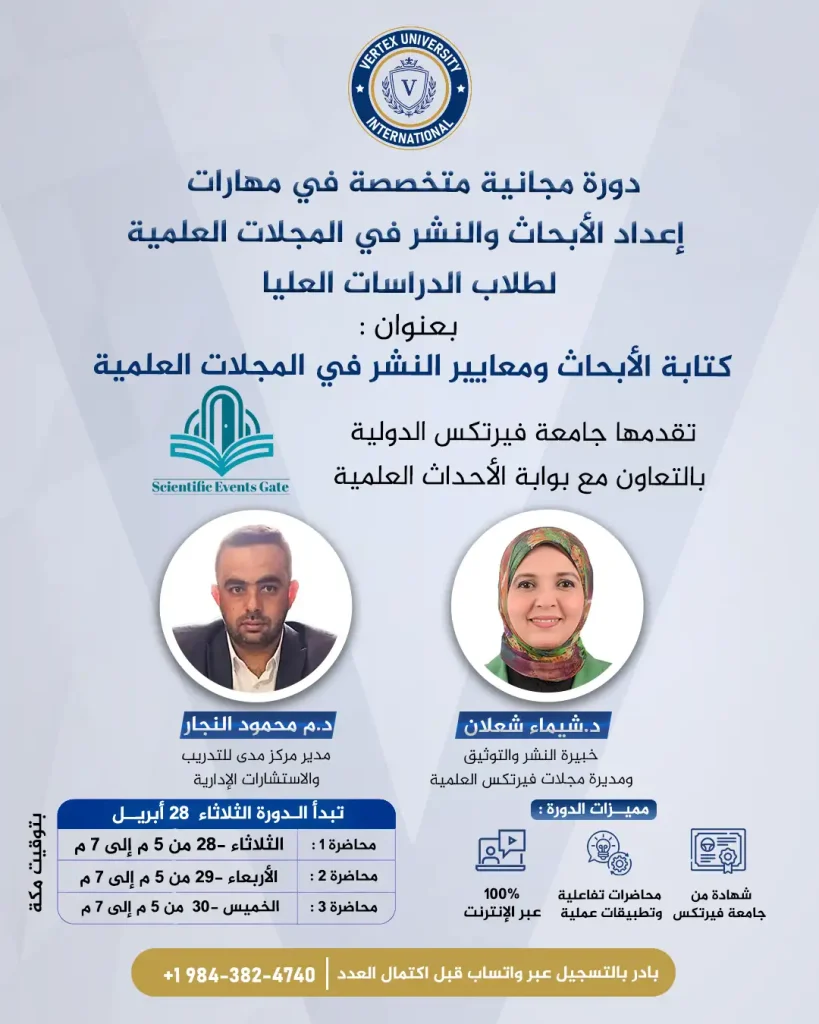
Vertex International University has announced the launch of a specialized training course titled Research Writing and Journal Publication Standards, as part of its academic mission to support scientific research and enhance researchers’ efficiency in meeting academic publishing requirements in accordance with international standards.
This research writing course comes in response to a growing need within academic communities to develop scientific writing skills, amid increasing competition for publication in peer-reviewed journals and rising expectations for quality and methodological rigor in research evaluation. Possessing research knowledge alone is no longer sufficient; mastering the tools to present and articulate it according to global publishing standards has become essential.
The Research Writing and Journal Publication Standards course is a professional introductory training program designed to provide participants with a comprehensive understanding of academic writing fundamentals, constructing a research paper based on a precise scientific methodology, and familiarizing them with the requirements of publishing in peer-reviewed journals and how to deal with them.
The program targets postgraduate students (Master’s and PhD), as well as researchers and academics seeking to develop their research skills and enhance their chances of publishing in accredited scientific journals, through an integrated understanding of the stages of research preparation, selecting appropriate journals, and dealing with the peer review process.
The program focuses on building core scientific writing skills and structuring research sections according to the (IMRAD) model, in addition to training participants on selecting suitable journals, preparing manuscripts according to author guidelines, understanding peer review mechanisms, and responding to reviewers’ comments. It also addresses publication ethics and avoiding plagiarism.
The course is delivered through an interactive training methodology that combines structured theoretical instruction with practical application, enabling participants to transform knowledge into applicable skills for their actual research projects.
The program serves as a structured academic entry point that establishes a professional pathway in scientific research and international publishing, paving the way for advancement in scholarly output and academic promotion.
About the Course in Brief: A Training Program Designed to Be a Real Academic Advantage in the Research Journey
Training Program Details
- Course Title: Research Writing and Journal Publication Standards
- Course Type: Developmental Training Course
- Duration: 3 days, totaling 6 training hours (2 hours per day)
- Mode of Study: Online via Vertex University’s digital platform
- Target Audience: Postgraduate students (Master’s and PhD)
- Certificate: Accredited certificate from Vertex University
The program delivers clear academic value through a design that combines scientific grounding with practical application, focusing on enabling participants to build complete research papers according to recognized scientific publishing standards, while aligning with peer-reviewed journal requirements and international indexing rules.
The research writing course content reflects modern practices in academic writing, with emphasis on applied aspects related to preparing research for publication, improving its quality, and increasing acceptance chances. This provides participants with a realistic understanding of the scientific publishing pathway and its actual requirements.
It also represents a foundational step in building an integrated academic pathway, enabling participants to transition from research preparation to professional publication, supported by a clear methodological understanding of review and evaluation stages.
Research Writing Course Beneficiaries: Who Is This Program Designed For?
This course is designed to serve multiple academic and research groups in a context where demand for publishing skills is increasing as a critical factor in building academic careers and professional advancement. Publishing is no longer optional but has become a key criterion in evaluating research competence and competitiveness within the scientific community.
The course provides participants with a practical framework for understanding international publishing requirements and helps them transition from preparing research to presenting it professionally in alignment with peer-reviewed journal standards and global indexing systems. It also helps bridge the gap between research knowledge and publishing requirements through structured training that connects content quality with presentation and evaluation mechanisms.
Accordingly, the target groups include:
- Those seeking academic promotion and international publication:
• Understanding global indexing standards
• Supporting acceptance in Scopus and Web of Science journals - Graduates and research enthusiasts:
• Strong foundation in scientific writing
• Preparation for postgraduate studies - Master’s and PhD students:
• Improving academic writing skills
• Preparing research for publication and promotion
• Supporting thesis development - Researchers and faculty members:
• Increasing publication opportunities in peer-reviewed journals
• Enhancing research quality
• Supporting academic promotion requirements - Research center professionals:
• Developing skills in preparing scientific papers
• Applying academic standards in publishing
Training Program Modules: Translating into Practical Capability Aligned with Research and Academic Publishing Requirements
The program is structured into three main modules representing the research journey from writing to publication. It begins with foundational knowledge of scientific writing, moves to preparing research for publication, and concludes with understanding peer review mechanisms.
Module 1: Introduction to Scientific Writing and Academic Publishing (2 hours)
This module focuses on building foundational knowledge, including:
• Concept and types of scientific research
• Characteristics of peer-reviewed scientific papers
• Components of a research paper (IMRAD)
• Ethics of scientific research and publishing
Module 2: Preparing Research for Publication and Selecting the Right Journal (2 hours)
This module aims to equip participants with professional research preparation skills, including:
• Criteria for selecting scientific journals
• Indexing systems (Scopus – Web of Science)
• Impact Factor and Q1–Q4 rankings
• Distinguishing predatory from legitimate journals
• Formatting research according to journal guidelines
• Reference management
Module 3: Peer Review Process and Dealing with Reviewers (2 hours)
This module focuses on understanding peer review, including:
• Stages of the peer review process
• Journal decisions (Accept / Minor / Major / Reject)
• Common reasons for rejection
• How to respond to reviewers’ comments
• Preparing a response letter
• Strategies for improving research after revision
By the end of the program, participants will be able to understand scientific writing requirements, construct a complete research paper, select appropriate journals, and professionally deal with the peer review process, contributing to improved research quality and higher publication acceptance rates.
How Does The Research Writing Course Align with Contemporary Research Needs?
The research writing course reflects the evolving nature of scientific research, where the focus is no longer limited to knowledge production but extends to how it is presented and published according to precise standards ensuring acceptance within the academic community.
Scientific publishing has become a fundamental component of academic performance evaluation, increasing the importance of mastering scientific writing skills and understanding journal requirements, making this program essential for preparing researchers for current academic demands.
Training Outcomes
By the end of the research writing course, participants are expected to be able to:
- Write a complete research paper according to academic standards.
- Structure research sections according to the (IMRAD) model.
- Accurately select appropriate journals based on indexing criteria.
- Prepare research for publication according to journal requirements.
- Distinguish between predatory and legitimate journals.
- Deal professionally with the peer review process.
- Prepare structured responses to reviewers’ comments.
- Reduce rejection rates and increase acceptance chances.
Training Tools and Methods
The program is delivered online via Vertex University’s platform using an interactive methodology that includes:
• Interactive theoretical lectures
• Discussions and dialogue
• Practical exercises
• Scientific case studies
• Presentations
• Ongoing assessments
• Individual and group practical applications
Vertex University: Supporting Scientific Research and Building Academic Competence
This program is part of Vertex University’s direction toward advancing scientific research by designing training programs aligned with researchers’ needs and transforming academic skills into practical tools applicable in the scientific publishing pathway.
The university relies on a flexible digital learning environment that ensures efficient access to knowledge while maintaining academic depth, contributing to preparing researchers capable of competing in international publishing environments.
Advantages of Enrolling in This Training Program at Vertex International University
- Training program offered by a specialized university
• Modern content aligned with scientific publishing requirements
• Introductory course that opens a comprehensive academic pathway
• Accredited certificate that strengthens the CV
• Interactive design based on practical application
• Suitable for postgraduate students and researchers
• Flexible online delivery
• Real added value in publishing and academic promotion pathways
• Academic supervision and accredited teaching methodology
• Alignment with the university’s academic track
The research writing course represents a practical opportunity for researchers and postgraduate students to develop their scientific writing skills and build an academic pathway based on research quality and publishing efficiency, enhancing their scholarly presence and meeting international publishing standards.