 Arabic
  English

Vertex International University places considerable attention on scientific events that provide academics, researchers, and specialists with an opportunity to discuss topics related to current knowledge and ongoing work in the fields of science, technology, and business. These activities include lectures, scientific meetings, and training programs, with an emphasis on hosting experienced professionals and specialists to make knowledge accessible to students, researchers, and those interested in these fields.
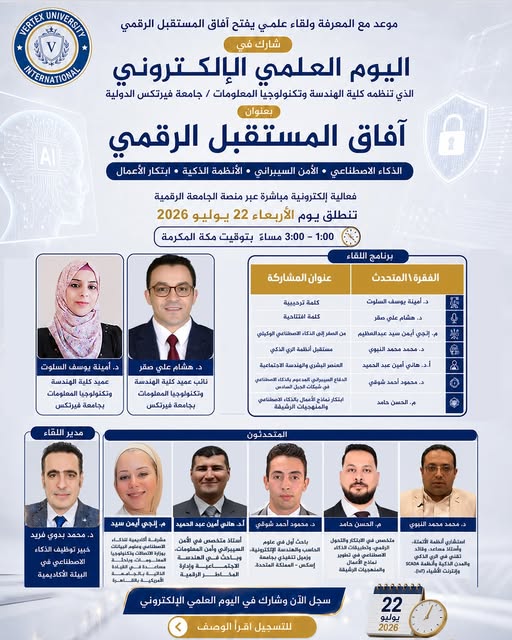
Among the events organized by the University in this context was the online scientific day, “Horizons of the Digital Future: Artificial Intelligence • Cybersecurity • Smart Systems • Business Innovation.” The event brought together a group of specialists who addressed a range of topics, beginning with applications of artificial intelligence and extending to cybersecurity, smart systems, communications, and business model innovation.
Scientific events enable the University to engage with expertise across different fields
Modern technology topics intersect across many practical applications, and this was clearly reflected in the program of the scientific day. Artificial intelligence is connected to smart systems, cybersecurity intersects with communications networks, while applications in these fields extend to agriculture, business, and other sectors. The event brought together academics and specialists from different backgrounds, with each participant addressing a specific aspect of these topics. The sessions were moderated by Dr. Mohamed Badawy Farid, an expert in the application of artificial intelligence in academic environments, who coordinated the discussions and managed the scientific themes of the event.
Eng. Engy Ayman Sayed Abdelazim, Academic Supervisor of Artificial Intelligence and Data Science at the Ministry of Communications and Information Technology and Assistant Researcher in Autonomous Driving at the American University in Cairo, delivered a lecture titled “From Zero to Agentic AI.” The lecture examined the development of artificial intelligence applications, leading to systems capable of carrying out multiple tasks and handling decisions with greater degrees of autonomy.
Dr. Mohamed Mohamed El-Nabawy, Automation Systems Consultant, Assistant Professor, and Technical Lead in smart irrigation, smart cities, SCADA systems, and the Internet of Things, addressed “The Future of Smart Irrigation Systems,” presenting the use of smart technologies and the Internet of Things in water resource management and their applications in the agricultural sector.
Addressing the human aspect of digital security, Prof. Dr. Hany Amin Abdel Hamid, a specialist in cybersecurity and information security and a researcher in social engineering and digital risk management, presented “The Human Element and Social Engineering.” His presentation focused on the impact of human behavior and awareness of risks on information protection and on dealing with exploitation attempts and digital attacks.
Dr. Mahmoud Ahmed Shawky, a specialist in cybersecurity and modern communications networks, addressed “AI-Powered Cyber Defense in 6G Networks.” His presentation examined several directions in integrating artificial intelligence with cyber defense systems in future communications networks.
The program concluded with a lecture by Eng. Al-Hassan Hamed, a specialist in innovation, digital transformation, and the use of artificial intelligence in developing business models and agile methodologies. His presentation, titled “Innovating Business Models with Artificial Intelligence and Agile Methodologies,” explored the use of AI in designing more flexible business models and working approaches.
The change in the College’s name was part of a review of academic terminology for programs and specializations
The scientific day was organized by the College of Engineering and Information Technology at the University, which was the College’s name at the time the event was held. The College’s current academic name is the College of Computing and Information Technology.
The change in the name came as part of a review of academic terminology to more accurately reflect the nature of the specializations offered by the College and to align with commonly used academic terminology in the fields of computing and information technology. The accuracy of an academic title has practical implications for students, particularly in relation to academic documents and certificates and when identifying their specialization for higher education institutions, qualification authentication and equivalency procedures, as well as when presenting their qualifications to employers. For this reason, the University considers the names of its Colleges and programs part of the academic accuracy that should be reflected in students’ official documents and academic paths.
Publishing recordings of the scientific day expands access to the content presented by the participants
The online scientific day “Horizons of the Digital Future” is part of a series of events organized by the University to host specialists and address a range of scientific and professional topics. These events continue to provide a space for communication among faculty members, researchers, students, and experts, while making part of this content available to the public through the University’s digital platforms.
The benefit of the scientific day was not limited to those who attended its sessions when it took place. The University documents its events by publishing part of their scientific content through its digital platforms, allowing the lectures to remain available after the event and enabling students to return to topics of interest for use in their studies or research.
Vertex International University has published recordings of the event through its official YouTube channel, allowing students, researchers, and interested viewers to return to the lectures and listen to the contributions presented by the participating specialists.
Watch the Online Scientific Day events here