 Arabic
  English
Vertex International University has announced the launch of a specialized training course titled “Fundamentals of Artificial Intelligence and Its Use in Scientific Research”, as part of an academic pathway aimed at redefining the role of digital tools within the research process, transforming them from marginal supporting utilities into conscious components in knowledge construction and scholarly writing. This direction reflects a deep awareness of the structural changes that have reshaped scientific research, where research competence extends beyond data collection and analysis to include the ability to manage knowledge through intelligent tools that require critical and methodological understanding.
The program operates within a scientific context where technology intersects with methodology, and where artificial intelligence capabilities intertwine with the researcher’s intellectual skills. The contemporary research landscape does not tolerate random use of intelligent tools, nor does it accept uncontrolled dependence on them. It requires a precise approach that balances benefiting from technological capabilities while preserving academic integrity. This need has created demand for training programs that present such balance in the form of structured, applicable knowledge, forming the foundation upon which this program is built.
The course provides a comprehensive introduction to the fundamentals of artificial intelligence, with a direct connection to its functions within scientific research. Participants gain insight into the nature of these tools, how they operate, and the boundaries that regulate their use. The approach goes beyond theoretical definitions and moves toward applied training, placing the researcher in realistic academic scenarios where AI tools are used as active elements in idea development, content organization, and academic language enhancement.
The scope of the program extends across multiple academic segments, beginning with undergraduate students seeking to build a solid foundation in research skills, moving to postgraduate students developing their research projects, and including researchers and faculty members engaged in continuous academic production. This diversity in target groups gives the program flexibility, allowing it to deliver content adaptable to different levels of research experience.
The program design is based on a clear conceptualization of artificial intelligence within the research process. Intelligent tools are presented as extensions of the researcher’s capabilities, enhancing efficiency and supporting organization while preserving the researcher’s authority over final academic decisions. This perspective reduces tendencies toward full technological dependence and establishes a framework for conscious use grounded in understanding, evaluation, and continuous review.
Course Overview: A Training Program for Conscious Use of Artificial Intelligence in Scientific Research
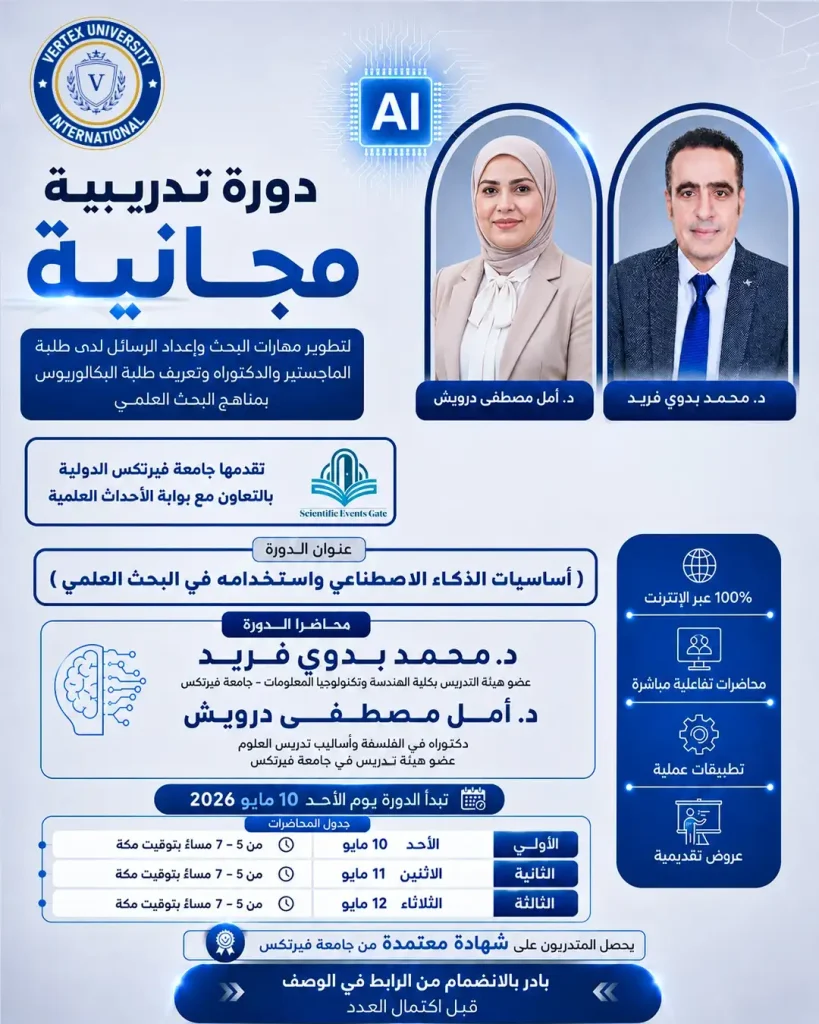
Course Title: Fundamentals of Artificial Intelligence and Its Use in Scientific Research
Course Type: Developmental Training Course
Program Duration: 3 days, totaling 6 training hours (2 hours per day)
Schedule: Sunday 10, Monday 11, Tuesday 12 May 2026
Session Time: 5:00 PM – 7:00 PM (Mecca Time)
Mode of Study: Online via Vertex University’s Digital Platform
Target Audience: Undergraduate and postgraduate students, researchers
Certification: Accredited certificate from Vertex International University
Course Instructor: Dr. Mohamed Badawi Farid
This program delivers value that goes beyond direct instruction by linking the theoretical foundations of artificial intelligence with its real-world applications in academic research. The aim is not limited to presenting technical knowledge but extends to building academic awareness that defines when and how such tools can be used, and what remains acceptable within scholarly standards. As a result, participants develop the ability to treat artificial intelligence as an analytical and organizational tool rather than a rapid content-generation mechanism.
Fundamentals of Artificial Intelligence and Its Use in Scientific Research: Who Is This Program Designed For?
The program is structured to serve diverse academic groups united by a shared interest in improving research performance within an environment where digital tools are becoming increasingly essential. Each group finds relevant value within the program according to its stage of academic development.
Undergraduate Students:
• Building a methodological foundation in research thinking
• Gaining early awareness of AI tools in academic study
• Developing the ability to organize ideas into clear scientific content
Postgraduate Students:
• Supporting thesis and dissertation development with higher precision
• Enhancing academic writing quality and clarity
• Utilizing AI tools in literature analysis and structured summarization
Researchers and Faculty Members:
• Strengthening scientific productivity
• Advancing knowledge management and analytical methods
• Reducing research preparation time without compromising quality
Individuals Interested in Research:
• Developing a deeper understanding of AI applications in academia
• Learning responsible and structured tool usage
• Building a balanced perspective that integrates technology with methodology
Program Modules: From Conceptual Understanding to Practical Application
The program follows a structured training framework that progresses from foundational concepts to applied practice, ensuring a comprehensive learning experience.
- Module One: Introduction to Artificial Intelligence and Academic Applications
This module establishes a solid knowledge base, addressing artificial intelligence in terms of definition, development, and context. Participants explore the origins of AI technologies and their evolution into integral components of academic environments, along with an overview of major types and current applications.
- Definition and historical development of artificial intelligence
- Types of AI and their applications across domains
- Key tools and platforms used in scientific research
- Opportunities and challenges associated with academic use
This module prepares participants to understand the tools they will use and builds a foundation that prevents unstructured or uninformed application.
- Module Two: Applying Artificial Intelligence in Research Stages
This module shifts toward direct application, demonstrating how intelligent tools can be integrated into different stages of research work. Participants engage with practical scenarios, from selecting research topics to structuring and refining academic content.
- Using AI to develop research ideas and define problems
- Supporting the formulation of research questions and objectives
- Applying tools in literature review and summarization
- Enhancing academic writing and scientific paraphrasing
This module provides practical experience that highlights the real value of AI tools when used within a structured framework.
- Module Three: Ethics of Use and Practical Applications
This module addresses one of the most critical aspects of artificial intelligence in research: ethical use. Participants learn how to distinguish acceptable practices and maintain academic integrity while working with intelligent tools.
- Ethical and academic guidelines for AI usage
- Evaluating accuracy and addressing bias and misinformation
- Methods for documenting AI-assisted work when required
- Practical applications and real research case studies
- A mini project to build an AI-supported research workflow
This module reinforces critical awareness, enabling participants to make informed and responsible research decisions.
Course Outcomes
By the end of the program, participants are expected to acquire competencies that reflect their ability to integrate artificial intelligence into research work in a balanced manner:
- Understanding core AI concepts and applications
- Using intelligent tools in research preparation
- Evaluating outputs for accuracy and reliability
- Adhering to ethical standards in academic usage
- Improving academic writing and content organization
These outcomes represent not only knowledge acquisition but also a shift in how researchers approach their work.
- Training Methods and Tools
The program adopts an interactive approach that combines theoretical explanation with practical implementation, creating an experience grounded in active participation:
- Live interactive lectures
- Real-time demonstrations of tools
- Group discussions on research scenarios
- In-session practical exercises
- Individual activities to develop applied skills
This diversity in methods supports deeper understanding and enhances the participant’s ability to transfer knowledge into real academic contexts.
- How Does This Course Align with Contemporary Research Transformations?
The transformation in scientific research relates to how knowledge is managed rather than simply how much is produced. Artificial intelligence tools expand the researcher’s capabilities while introducing challenges related to accuracy, credibility, and responsible use. This reality requires researchers to develop new competencies that integrate technical understanding with methodological awareness.
The program addresses this need by offering a structured framework that enables researchers to use AI in ways that enhance research quality while maintaining control over outputs. This balance represents a core element of modern research competence.
Vertex University: Toward Conscious Integration of Technology in Research
Vertex University develops training programs aligned with contemporary transformations in education and research, focusing on building competencies capable of engaging with modern technologies through structured awareness. Its digital learning environment allows for the delivery of specialized academic content in a flexible and accessible format.
This direction is reflected in program design that moves beyond knowledge transfer toward transforming learning into applicable academic skills.
- Program Benefits
- Accredited certificate from Vertex International University
- Up-to-date content linking AI with scientific research
- Practical training on intelligent tools
- Development of output evaluation and verification skills
- Strengthening awareness of academic ethics
- Improvement of writing, summarization, and organization skills
- Interactive training design based on application
- Suitable for diverse academic audiences
This program represents a practical step toward a deeper understanding of artificial intelligence as a research tool, equipping participants with capabilities that enhance academic performance within a framework that integrates technical efficiency with scholarly discipline.