 Arabic
  English
  French

In the context of contemporary economic transformations, improving quality of life is no longer limited to increasing income; it is closely tied to an individual’s effective time management and allocating resources toward long-term investments. Among these, education stands out as a central tool for building human capital. However, in its traditional forms, this type of investment faces practical constraints that often lead many individuals—especially those already engaged in the workforce—to postpone it.
In this regard, we examine a case study through which we address a pressing question in today’s reality:
How can one access better career opportunities to improve income and secure the future?
A Typical Case: An Employee Seeking Progress Within Real Constraints
This case represents a broad segment of individuals who hold relatively stable jobs and possess a growing awareness of the importance of developing their skills and enhancing their career prospects. This profile recognizes that career advancement is no longer determined solely by seniority, but requires additional qualifications, analytical capabilities, and academic credentials that reflect a higher level of competence.
Despite this awareness, the investment decision is hindered by several obstacles. Traditional education often requires partial or full-time commitment, implying the sacrifice of time that could otherwise be used to work or increase current income. In addition, both direct costs—such as tuition—and indirect costs—such as transportation and rigid schedules—raise the overall cost of the decision, sometimes beyond the expected short-term return.
In such a situation, “postponing investment” appears to be a rational choice, reinforcing a state of stability without growth, ultimately leading to diminished ambition and the absence of a practical, actionable pathway forward.
Time Management as a Decisive Factor in Investment Decisions
This case highlights that the core issue lies in the conflict of resources, particularly time management. When investing in education requires a fundamental restructuring of one’s daily schedule, the decision becomes costly from an opportunity cost perspective.
However, this perception shifts significantly when a flexible learning model is introduced—one that redefines the relationship between learning and time. Distance education allows the learning process to be integrated into daily routines rather than displacing them, transforming time from a limited resource into one that can be reshaped and optimized.
In this model, education becomes part of one’s lifestyle, organized according to personal priorities without disrupting professional or personal commitments. This shift not only influences the educational decision but also enhances quality of life by reducing pressure and increasing a sense of control over one’s personal and professional trajectory.
Distance Learning: An Investment Opportunity with Compounding Returns
Once constraints related to time management and location are removed, the entire investment equation changes. Distance learning offers a relatively low-cost model that eliminates transportation expenses and rigid time commitments, while still providing academic content and practical training that can be directly applied in the workplace.
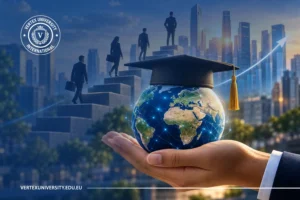
In this sense, education becomes an investment with compounding returns. Its impact extends beyond obtaining a degree to improving current performance, unlocking better career opportunities, and increasing productivity—factors that gradually translate into higher income and greater professional stability.
Given these conditions, ignoring such an opportunity becomes economically and rationally unjustifiable, especially when the alternative is remaining in a static situation with limited growth potential.
A Model Case Within Vertex University’s Strategic Vision
This case demonstrates that the real challenge facing education—and limiting its positive impact on quality of life—lies in its traditional format, which has become less viable under current conditions. With the advancement of digital learning models, however, this investment can now be transformed into a practical and accessible option without sacrificing stability.
From this perspective, Vertex University builds its educational strategy around this very segment: individuals who possess the motivation but require a flexible model that enables progress without disrupting their lives. Through its fully online distance learning system, Vertex offers a genuine opportunity to rebalance work and education, transforming time into a tool for growth, enhancing career prospects, and ultimately increasing income levels.