 Arabic
  English
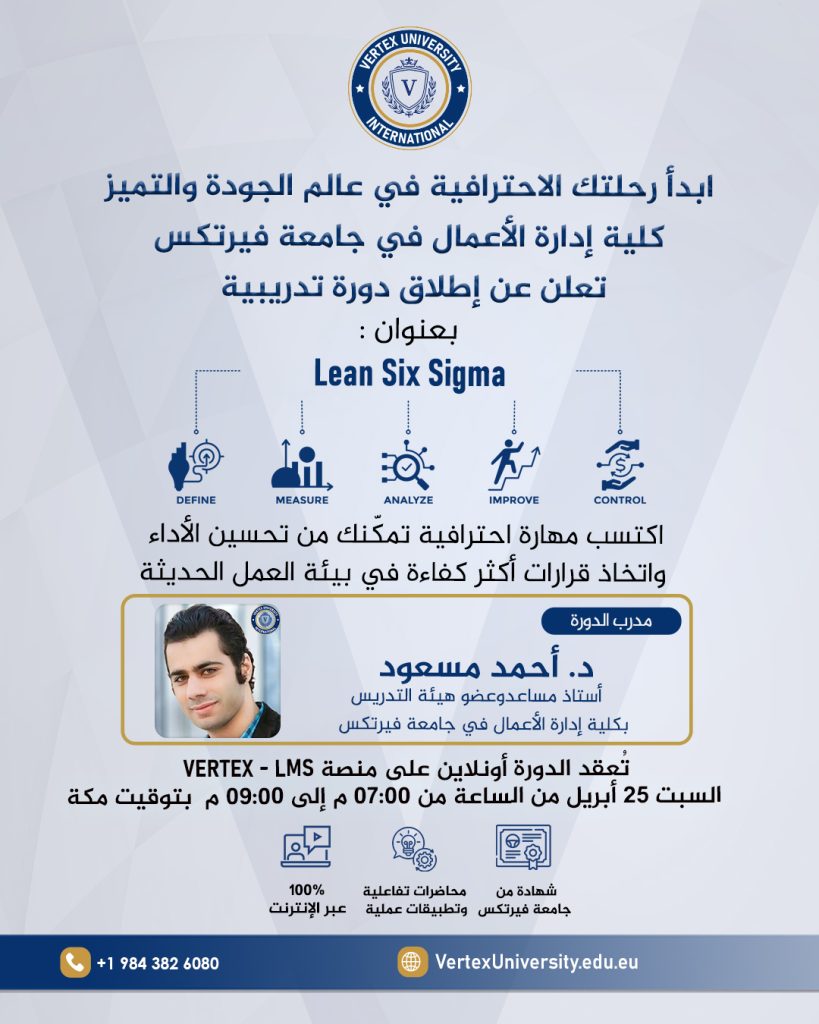
Vertex International University has announced the launch of a specialized training program titled “Lean–Six Sigma Methodology for Quality Management and Process Improvement,” targeted at students of the Faculty of Business Administration. This initiative is part of the university’s broader academic efforts to develop students’ applied competencies and strengthen their ability to connect theoretical knowledge with institutional work requirements in the fields of quality and operations management.
The introduction of this program aligns with a growing institutional focus on restructuring operational systems based on higher levels of precision and efficiency. Performance improvement is no longer driven by individual judgment, but rather by structured methodologies capable of analyzing processes, measuring outcomes, and systematically identifying sources of waste. Within this context, there is an increasing need for tools that enable a deeper understanding of internal workflows and provide actionable, data-driven solutions.
Accordingly, the program presents an applied framework that integrates two complementary managerial approaches. Lean Management focuses on improving process flow by eliminating non-value-adding activities, while Six Sigma concentrates on reducing errors and variations in outputs through rigorous analytical tools. The integration of these approaches leads to a comprehensive model for managing operations, balancing execution speed with output accuracy, and enhancing the ability to make data-driven operational decisions.
Brief Overview of the Training Program
Program Title: Lean–Six Sigma Methodology for Quality Management and Process Improvement
Program Classification: Quality Management and Operations
Program Duration: Two-hour workshop
Mode of Delivery: Online via the Vertex University platform
Date: April 25, 2026
Time: 7:00 PM – 9:00 PM (Makkah Time)
Instructor: Dr. Ahmed Massoud – Assistant Professor, Faculty of Business Administration
Certification: Certificate of Attendance issued by Vertex University
The program serves as a practical entry point for understanding how to improve operational processes through a methodology grounded in measurement and analysis. It aims to achieve a high level of quality performance, targeting no more than 3.4 defects per million opportunities—a benchmark that reflects a highly controlled operational environment. The program goes beyond conceptual explanation, focusing instead on transforming knowledge into practical tools for diagnosing and addressing root causes of operational challenges.
It also reinforces the principle of data-driven decision-making rather than reliance on subjective judgment, emphasizing that performance improvement begins with refining processes rather than attributing blame to individuals. In addition, the program introduces the “pull system,” which contributes to better production flow, reduced inventory levels, and the prevention of overproduction, thereby supporting more efficient resource management.
Program Content and Structure
The program is structured around a set of integrated modules that reflect the comprehensive nature of process improvement methodologies. It begins with an introductory module that defines the Lean–Six Sigma approach and its relevance in modern organizational settings. It then progresses to the principles of Lean Management, which focus on optimizing workflow and eliminating non-value-adding activities.
The program further addresses the fundamentals of Six Sigma, with particular emphasis on the five-stage improvement methodology: Define, Measure, Analyze, Improve, and Control. These stages provide a structured framework for systematically addressing operational challenges.
In addition, the program includes a dedicated module on analytical and measurement tools that support performance evaluation, alongside a module focused on fostering a culture of continuous improvement within organizations, where development becomes an ongoing practice rather than a temporary initiative.
Participants will also be trained to identify the eight types of waste within processes and develop strategies to reduce them, thereby enhancing operational efficiency. The program incorporates practical tools for workplace organization and error prevention systems, which help minimize defects and improve output quality.
Moreover, participants will learn how to map process flows to distinguish value-adding activities from non-value-adding ones, as well as how to identify and address bottlenecks within workflows, contributing to smoother and more efficient operational performance.
Key Features of the Training Approach
- Training methods derived from contemporary work environments
The program is delivered through the university’s digital platform using an interactive training approach that combines theoretical lectures, structured discussions, and applied exercises. It also includes real-world case analysis, organized presentations, short assessments to evaluate comprehension, and both individual and group-based practical applications that enhance analytical and decision-making skills. - Alignment with labor market requirements
This program reflects a clear organizational direction toward improving operational efficiency. The ability to analyze performance, reduce waste, and enhance quality has become a fundamental competency across sectors. Mastering this methodology provides participants with a deeper understanding of organizational dynamics and equips them to address operational challenges using a structured, analytical approach.
Vertex University: Structuring Training Programs Based on a Forward-Looking Vision
This program is part of Vertex International University’s vision to design educational offerings that are aligned with labor market demands. By analyzing professional challenges and translating them into applied training content, the university ensures a balanced integration of academic foundations and practical application, contributing to the preparation of graduates capable of making a meaningful impact in professional environments.
Key Benefits of the Lean–Six Sigma Program at Vertex University
- The program represents a valuable addition to participants’ academic and professional development, as it is delivered within a structured educational framework that focuses on enhancing process analysis and performance improvement skills based on internationally recognized methodologies. Its design integrates theoretical knowledge with practical application, enabling participants to gain a comprehensive understanding of efficient and precise process management.
- It offers contemporary training content that reflects professional practices in quality management and process improvement, with a strong emphasis on data-driven decision-making, workflow analysis, and waste reduction, providing participants with practical tools directly applicable in real-world contexts.
- The program serves as a methodological foundation for building a professional pathway in operations management, offering a knowledge base that supports progression toward more specialized programs. Participants receive an accredited certificate of attendance from Vertex University, strengthening their professional profile and enhancing their curriculum vitae.
- The training is based on an interactive approach that combines applied explanation, case analysis, professional discussions, and practical exercises, ensuring the transformation of theoretical concepts into applicable skills. The online delivery format provides flexibility, allowing participants to benefit without conflicting with their academic or professional commitments.
- The program delivers clear professional value by developing participants’ ability to improve performance, enhance operational efficiency, and address organizational challenges, thereby strengthening their readiness for future roles that require analytical thinking and data-driven decision-making.
Vertex International University has officially opened registration for the Lean–Six Sigma Methodology for Quality Management and Process Improvement program, as part of its training initiatives aimed at equipping students with analytical and applied competencies that enhance their professional readiness.
Interested applicants can view full details and register:
https://vertexuniversity.edu.eu/registration-training-programs-development/
This course is part of a series of academic initiatives through which the university develops integrated professional pathways and enhances students’ readiness to meet the evolving demands of quality management and operational excellence across diverse sectors.